System Design - CAP theorem, ACID, BASE and PACELC
December 22, 2025 |
system-design,
data
Notes on CAP theorem, ACID, BASE and PACELC regarding system design.
ACID#
- Focuses on precision/data reliability
- Related to transactional models
- Atomicity, Consistency, Isolation, Durability
- Transactional databases
- SQL Databases
- Atomic and reliable transactions
- Prioritization of transaction and commits
- Detriments performance and availability
Atomicity#
- Ensures that each transaction is treated as an indivisible unit
- “All or nothing”
- All operations within the transaction should be completed
- Otherwise, nothing will be applied
- Strong consistency
- Operations that require dependency
- i.e: create an order row of a particular product, while decrementing from the quantity of available product
- Financial market – persist the credit while decrementing the users balance
Consistency#
- Guarantees that all transactions that happen, can only bring the current consistent state, to another consistent state
- Ensures that we do not corrupt/invalidate the data – data integrity
- Transaction validation
- Respects that all data restrictions are maintained: Types, Foreign Keys, Nullability, Triggers, etc.
- I.e. if we try to insert a string in a INT column
- If we try to insert a FK into a column, and that FK does not exist
Isolation#
- Operates independently and simultaneously of other transactions
- Transactions happening at the same moment do not interfere with others
- Dirty Reads
- Reading data that was modified by another transaction which has not yet been applied
- Say we have 2 transactions reading the same table. One transaction can not continue, without the other transaction finishing.
- Non-repeatable Reads
- A transaction reads the same row twice and gets different values each time. This happens because another transaction modified (and committed) that row in between the two reads.
- Phantom Reads
- A transaction re-executes a query that returns a set of rows, and new rows appear or existing rows disappear in the result. Because another transaction inserted, deleted, or updated rows that match the query condition and committed in between.
- Unlike non-repeatable reads (which involve the same row changing), phantom reads involve changes to the set of rows.
Durability#
- After the confirmation of a particular operation, the data will not be lost
- I.e.: after a
COMMIT, the data is guaranteed to be stored
- I.e.: after a
- Confirmed, a transaction will exist permanently
- Persistence of data in a non-volatile source
BASE and Eventual State#
- Basic Availability, Soft-State and Eventual Consistency
- Focuses on flexibility
- Flexibility for more large-scale distributed systems
- Partially contrary to ACID
- Availability and fault-tolerance are a priority
- Systems that have to deal with eventual consistency
- Databases BASE are more towards performance and high availability, in exchange to not being so consistent
- Mostly NoSQL databases
- Mongo, Cassandra, etc.
Basic Availability#
- Maximizes availability
- Guarantees a total and uninterruptible availability, and offers mechanism to work in a degraded or partial state
- I.e. If we have a database with three nodes, and one node fails, it can show a partial number of data (not all)
- Some data or functionality may not be available
- Allows replication and partitioning (sharding)
- Useful for large-scale and high-demand environments, where partial data is
accepted
- Maintain consistent operation is more important than having an 100% up to date version of the data
Soft-State#
- System can change over time
- Data can expire (with a TTL) or updated by the database
- I.e.:
memcached,Redis, etc. - Ideal for cache systems
- I.e.:
- Volatile databases
- There is no guarantee that the system maintains consistency
Eventual Consistency#
- Non confirmation in all nodes
- Write operation can happen in a single node and not be confirmed with the other nodes
- Asynchronous replication
- For example, on a write operation, it may write in a single node and confirm, and later replicate this data to the other nodes
- The data can be inconsistent in many nodes for a limited time
- Performance oriented
- High availability and scalable
CAP Theorem#
- 3 principles: Consistency, Availability and Partition Tolerance
- Conceptual model
- Helps classify distributed and non-distributed databases
- Helps us consider scenarios and architectural choices that vary on Consistency, Availability and Partition Tolerance
- Can choose 2 of the 3 principles (choose 2)
- CA, CP, AP, etc.
- In a distributed system, we cannot achieve all three principles
- Offers a base for us to identify the limitations of any database
Components of CAP (C, A and P)#
Consistency (C)#
- Guarantee that all the nodes of a database with distributed data present the same data simultaneously
- Regardless of the node queried, all of them return the most recent version of that data
- Atomicity
- Financial systems and hospital registration are examples of such systems that require consistency
- Systems with
Consistencyare ACID with strong consistency
Availability (A)#
- Ensures that any request to the system will get a response
- Regardless whether the data is updated in a node
- Presumes that the data returned can or cannot be the most recent. Even for read or write operations.
- High performance, high volume and fast response time
- Detriments the guarantee of the actual data
- Mostly BASE systems
Partition Tolerance (P)#
- Systems can work when the replicas of my system is partitioned into two different versions (not a table partition)
- Distributed database capacity of maintaining an operational state
- Even on a degraded state, it can offer system continuity
- Databases geo-distributed, social networking, log aggregators, brokers, queues are all examples of such system
- More related to BASE systems
Combination#
Consistency and Partition Tolerance (CP)#
- Prioritizes the consistency and tolerance to partitioning
- Sacrifices availability
- Maintains consistency within all nodes that continue to operate in case of a network failure or partition
- Allows disabling inconsistent nodes, makes them unavailable until consistency
is restored
- “I rather be unavailable than inconsistent”
- “Inconsistency is non-negotiable”
- Mix of BASE and ACID systems
- We need to prioritize data precision, approximate transactional atomicity
- Examples such as MongoDB, Cassandra, Couchbase, Etcd, Consul, etc.
Availability and Partition Tolerance (AP)#
- Prioritizes high availability and partition tolerance
- Sacrifices consistency
- Every node stays available for querying, independently of its up to date state
- During the synchronization process, all nodes will continue responding
- More important than maintaining consistency
- Examples of such databases are: DynamoDB, CouchDB, Cassandra (depending on its configuration), SimpleDB, etc.
- Base systems
Consistency and Availability (CA)#
- Prioritizes consistency and availability
- Sensible to data partition
- In cases of a network failure or partition, the system can stay completely inoperational
- Centralized databases, traditional SQL databases, MySQL/MariaDB, PostgreSQL, Oracle, SQL Server, Redis Standalone, Memcached Standalone are all examples of such database
- Leans towards ACID rather than BASE
CAP model today#
- 2/3 is not extremely exclusive
- Excessive simplification is not real in modern technology
- Consistency and availability (on/off)
- Layers of unavailability – not on or off
- Level of Consistency is not binary
- We can have different levels of consistency
- There are moments where we are 100% consistent, while moments we are not
PACELC theorem#
- Complementary to CAP – used as an “extension to CAP”
- Helps us identify gaps that CAP does not cover (partition is not always available)
- Mainly related to AP, CP models
- Helps us understand the answer of:
- “What should the system prioritize when it’s not functioning correctly?”
- “What should it prioritize when a partitioning happens between the nodes?”
- “Is it possible to operate with more than one level of consistency?”
- When a Partitioning of network (P) happens between the nodes of the system, it is necessary to choose between Consistency (C) or Availability (A)
- If there is a partition (P), we should choose between Availability (A) and Consistency (C)
- If there is no partition, we choose between Latency (L) and Consistency (C)
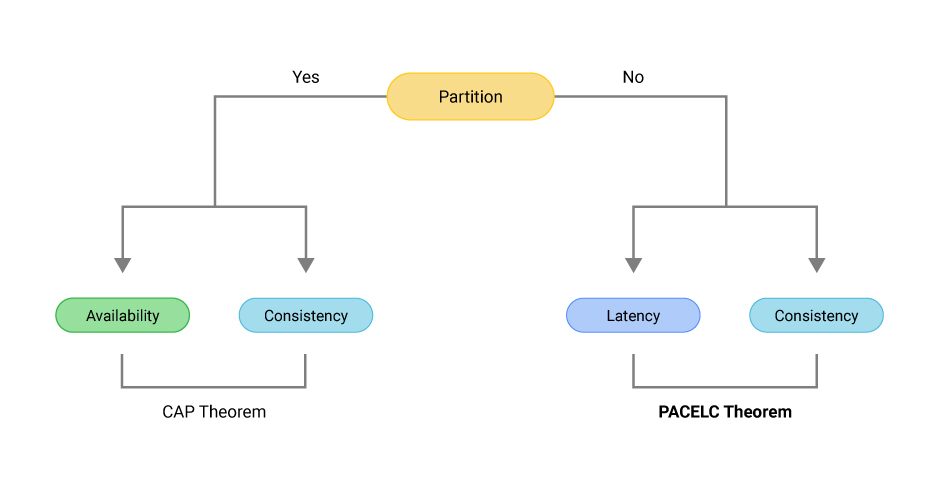
- Even on normal conditions, we have to make hard decisions
- More guarantee in exchange of response time
- Response time in exchange of Consistency
- Strong Consistency
- Eventual Consistency
- Both theorem are not mutually exclusive, but complementary to each other
Applying PACELC#
- PA/EL
- On Partition, Availability; Else, Latency
- Normal: Prioritizes latency instead of consistency
- In partition: Prioritizes availability instead of strong consistency
- Model of pure eventual consistency
- High write performance
- Accept versions different of the data
- PC/EL
- On Partition, Consistency; Else, Latency
- Normal: Prioritizes latency and high throughput in exchange of consistency
- In partition: Prioritizes consistency
- Can be unavailable until the cluster recovers and it comes back at operating
- Minimum consistency during failures is non-negotiable
- Accepts eventual consistency, but only when all nodes are available
- PA/EC
- On Partition, Availability; Else, Consistency
- Normal: Prioritizes strong Consistency
- In Partition: Prioritizes availability
- Assumes eventual consistency as a last resort
- CRDTs - Conflict-Free Replicated Data Types
- Hybrid context in microservices
- PC/EC
- On Partition, Consistency; Else, Consistency
- Normal: Prioritizes consistency instead of latency
- In partitions: Prioritizes consistency instead of availability
- Conservative model of consistency
- Data precision is the most important