System Design - Network
Review of some computer networking concepts and architecture.
Network protocols#
- Defines a communication pattern
- How one or more system can communicate with each other
- Set of rules that define the format and sequence of messages
- How they should be sent, received, structured.
- Ensures correct interpretation between different systems
- Different protocol implementation, with different standards and rules.
OSI model#
Conceptual model of how these different protocols relate to each other. Works like a map of where each functionality of these protocols lie.
Open System Interconnection
Standardizes the functionality of these protocols
7 abstraction layers
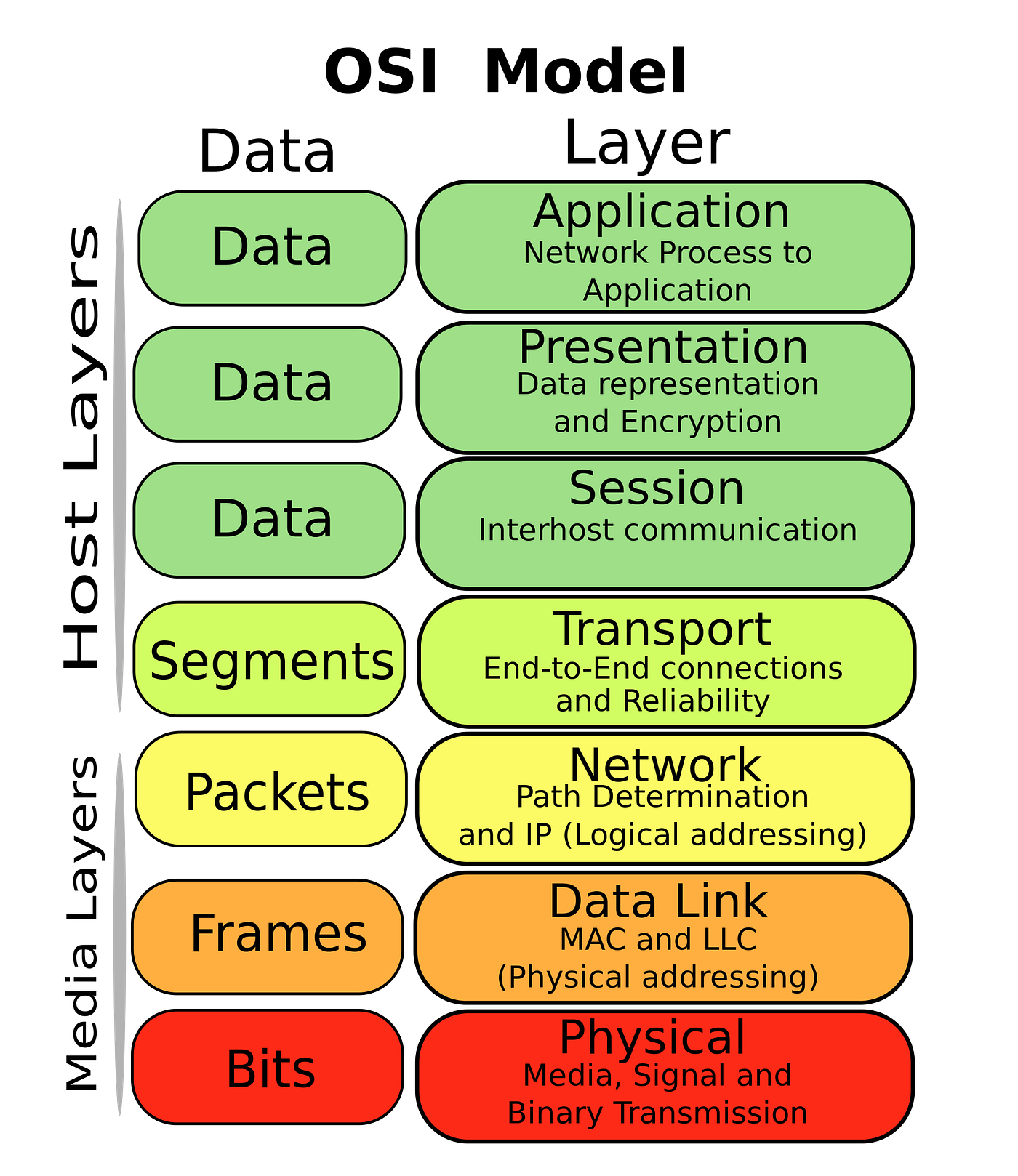
Software engineers generally work with
Application,PresentationandSessionlayers.- Application: HTTP, HTTPS, FTP, gRPC, Websockets, etc.
- Presentation: SSL/TLS, MIME, JPEG, GIF, etc.
- Session: RPC, SCP, SOCKS,
- Transport: TCP/UDP, etc.
- Network: IPv4, IPv6, etc.
- Data link: Point-to-Point Protocol, Mac Address
- Physical: Wires, WiFi, Binary, etc.
Flow of communication:
Request: 1..7 Response: 7..1
IP, IPv4 and IPv6 Protocol#
- Operates in the
Networklayer of the OSI model - Heart of data communication of the Internet.
- Allows devices to connect in an internal or external network
- Defines unique IP addresses for each device in the network
- IPv4 and IPv6 are the most common examples
IPv4 (Internet Protocol Version 4)#
- Oldest version and most used protocol
- 32-bit address format – allows 4.3 billion addresses of IPs
- Lack of IPv4 IPs available
- Private IP allocation
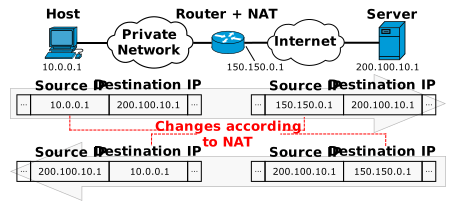
- NAT (Network Address Translation)
Most used protocol at the moment.
NAT (Network Address Translation)#
It’s a strategy/pattern
Proxy between networks (
private -> public)Allows multiple devices with private IPs to access the network through an unique IP
IPv6 (Internet Protocol Version 6)#
- Developed to resolve the problem of lack of IP addresses
- 128-bit format – Trilion of IP addresses
- IPsec (Internet Protocol Security)
- Packet processing in routers and offers a better security
Dual Stack#
Not all device network implementation works with IPv6. Dual stack allows IPv4 and IPv6 to live with each other and communicate with each other.
- Communication between networks that use IPv4 and IPv6
- Transition mechanism
- Requires a transition mechanism
- Direct addressing is not compatible
- Can communicate with IPv4 and IPv6
- Chooses between the appropriate protocol based on the destiny.
TCP and UDP#
Transport protocol.
UDP (User Datagram Protocol)#
- Belongs to the
Transportlayer of the OSI model - Smaller packets called Datagrams
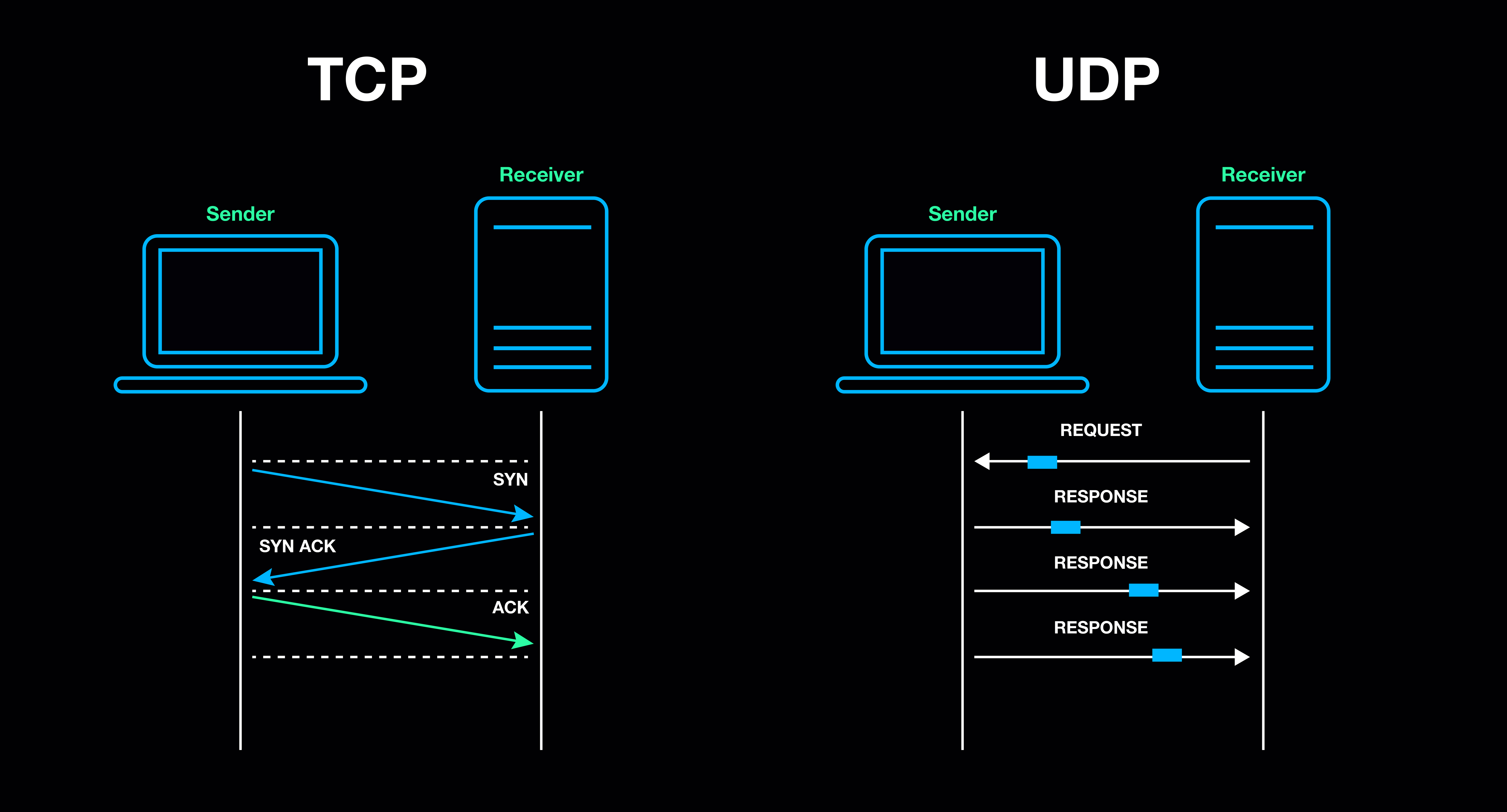
- Unreliable data transmission between hosts in the network
- We may loose packets during transmission
- No need to ACK whether we received the packet
- Fire and forget: no delivery guarantee
TCP (Transmission Control Protocol)#
- Belongs to the
Transportlayer of the OSI model - Protocol based on connection
- Opens, maintains, verifies and closes the connection
- Data sent to the host are reliable and ordered.
- Establishes a connection BEFORE any transmission of data between the hosts
- Three-way handshake
- SYN, SYN-ACK and ACK
SSL/TLS#
TLS (Transport Layer Security)#
- Successor of SSL
- Privacy and integrity of data
- Handshake during the session
- Public and private keys are exchanged
- Unique key per session
- Encrypts the transmitted data
- Belongs to the
Presentationlayer of the OSI model
DNS (Domain Name Service)#
- Domain name system
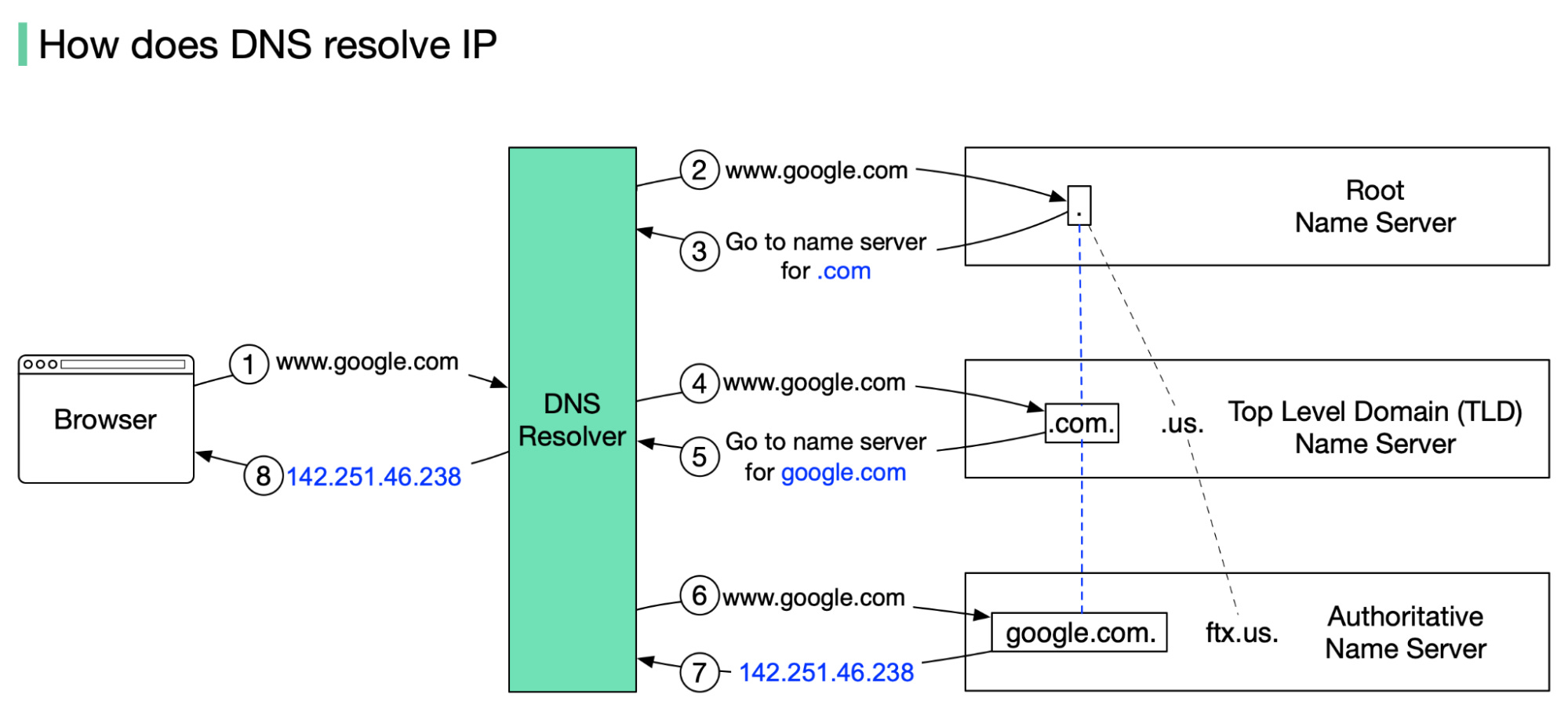
- Translates domain names into IPs
- Swaps friendly names to IPs
- Telephone list of the network
- Finds the proper IP for a particular site or service
- Recursive
Root Servers#
- Base hierarchy of the DNS
- 13 sets of the root DNS
TLD (Top-Level Domain)#
- Find top level domain for
.com
Authoritative#
- Responsible for knowing all the details of a domain
Example#
DNS calls when we type seds.nl:
dig +trace seds.nl; <<>> DiG 9.20.17 <<>> +trace seds.nl
;; global options: +cmd
. 513157 IN NS a.root-servers.net.
. 513157 IN NS b.root-servers.net.
. 513157 IN NS c.root-servers.net.
. 513157 IN NS d.root-servers.net.
. 513157 IN NS e.root-servers.net.
. 513157 IN NS f.root-servers.net.
. 513157 IN NS g.root-servers.net.
. 513157 IN NS h.root-servers.net.
. 513157 IN NS i.root-servers.net.
. 513157 IN NS j.root-servers.net.
. 513157 IN NS k.root-servers.net.
. 513157 IN NS l.root-servers.net.
. 513157 IN NS m.root-servers.net.
. 513157 IN RRSIG NS 8 0 518400 20260102050000 20251220040000 61809 . Fq0uact6cCRSrn/ej8lKyE5IjrOU/uljNMBx5tcVxhKb91S+MbroWVLy g35UAVS9lfS8xt5FwXE6r20603Kqz94A/8CSd++26L9Z2W0Sk31lSAPq 2xY5hhDJLLOMd/IG/xy617TYnf2wwN5F+qPsdwIqiajEwydmer2YdznL hu9PdR7kyAjUOwmn4RebH5GfQtJwmujsEhgynNhhjLTSy16kw9zg3XnR LLFDId8nocYZda8KDDAv0rYOXEmHHyRLCVp8sm7eWyOOLzdWRUfFsQ7A kOibT1HWwOW236W7TEGa931ACQpFfULRkTE3xJQuZulzLF+RoUJmHZRT Igj7RA==
;; Received 525 bytes from 192.168.50.1#53(192.168.50.1) in 14 ms
;; UDP setup with 2001:503:ba3e::2:30#53(2001:503:ba3e::2:30) for seds.nl failed: network unreachable.
;; no servers could be reached
;; UDP setup with 2001:503:ba3e::2:30#53(2001:503:ba3e::2:30) for seds.nl failed: network unreachable.
;; no servers could be reached
;; UDP setup with 2001:503:ba3e::2:30#53(2001:503:ba3e::2:30) for seds.nl failed: network unreachable.
;; UDP setup with 2001:500:2::c#53(2001:500:2::c) for seds.nl failed: network unreachable.
nl. 172800 IN NS ns1.dns.nl.
nl. 172800 IN NS ns3.dns.nl.
nl. 172800 IN NS ns4.dns.nl.
nl. 86400 IN DS 17153 13 2 C5DFDDC91E7532562A35F3C2CD30823894BE08F20101F1ABF45C8AB9 739F3F49
nl. 86400 IN RRSIG DS 8 1 86400 20260102050000 20251220040000 61809 . Q/uCDGUgvNI/rBKEPpL5rJLUuE1LXpGIL+MIt9IBX6BvjemxCuHJ+w0J +a+6FRutGC14+iOd0LDrZwvHAy+xP7HPbcEAKsluJwXY1wHPk3aPk9UD pH4HEhfi7aU1nFvQtDkCaKhuHfdIxvLRXoERKAiqK2/RqmvSqtQIZAfY J9KHc09QzVJcDhFDtAxm5aD6q72eCzDM6NbplzODkHaYTiwFARkgB1XF F1blw1e9oW2TN4viAYF1Uuq0+n+awu/JBxWcMNDezKr6PSkG45OjxiB2 WyBWnuTSWNGW5+xmumyYVlo5JbkgJRPEYMr/EuxaZh12tgHr8Xw5dezQ ATv3pA==
;; Received 561 bytes from 192.58.128.30#53(j.root-servers.net) in 16 ms
;; UDP setup with 2001:678:20::24#53(2001:678:20::24) for seds.nl failed: network unreachable.
;; UDP setup with 2620:10a:80ac::200#53(2620:10a:80ac::200) for seds.nl failed: network unreachable.
seds.nl. 3600 IN NS dave.ns.cloudflare.com.
seds.nl. 3600 IN NS diva.ns.cloudflare.com.
seds.nl. 3600 IN DS 2371 13 2 3C8B70CBFBDBE8E6605CE6205274B5955A929D84C4A8BD49088CD835 8CF5335B
seds.nl. 3600 IN RRSIG DS 13 2 3600 20260101220704 20251219070720 37807 nl. ubYajyZrOJccCp2GK+VAmbvf6RzSIFQXVLr37JeYOKB/DXfnWVKYgcen IrSYn/86cUDY0WPXw8L0pcKJPROcTg==
;; Received 237 bytes from 185.159.199.200#53(ns4.dns.nl) in 20 ms
;; UDP setup with 2606:4700:58::adf5:3b6d#53(2606:4700:58::adf5:3b6d) for seds.nl failed: network unreachable.
seds.nl. 120 IN A 63.176.8.218
seds.nl. 120 IN A 35.157.26.135
seds.nl. 120 IN RRSIG A 13 2 120 20251221151738 20251219131738 34505 seds.nl. Ha58AyZ9+CuXk9KyN4n50xk9e7Qcgjp3i41dd3IXdfbGzCv82QS7lnyM 3EmIp+OO5uNDsvFt6rRBXXu6T3YW8Q==
;; Received 171 bytes from 172.64.33.109#53(dave.ns.cloudflare.com) in 18 msDHCP (Dynamic Host Configuration Protocol)#
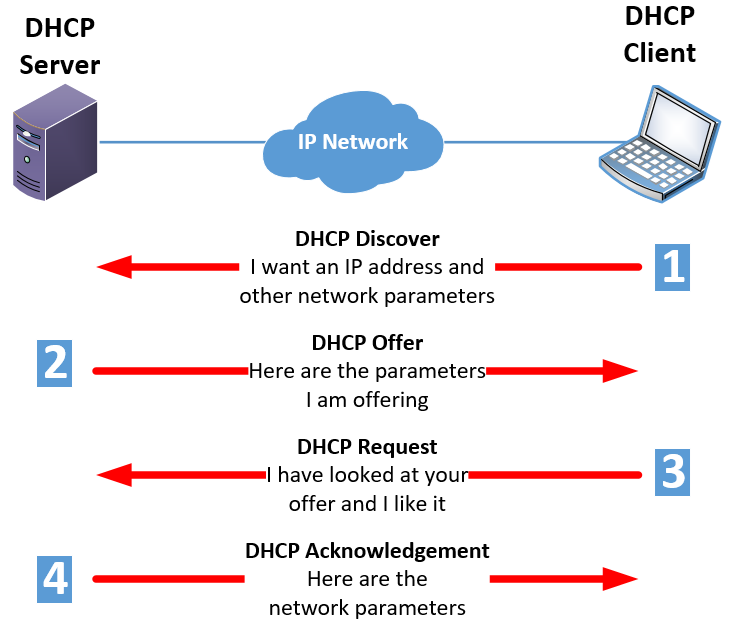
- Eases IP attribution in small networks (home, bars, etc)
- Dynamic configuration of hosts
- Designates automatically an IP address for a particular host
- Reduces address conflict
- DORA – 4 main steps
- Discovery
- Offer
- Request
- Acknowledgment
HTTP/1, HTTP/2 and HTTP/3 Protocols#
- Layer 7 of the OSI model
- Built on top of TCP/IP
- Request/Response
- Client/Server
- Synchronous protocols
- Body, headers, cookies, status code, etc.
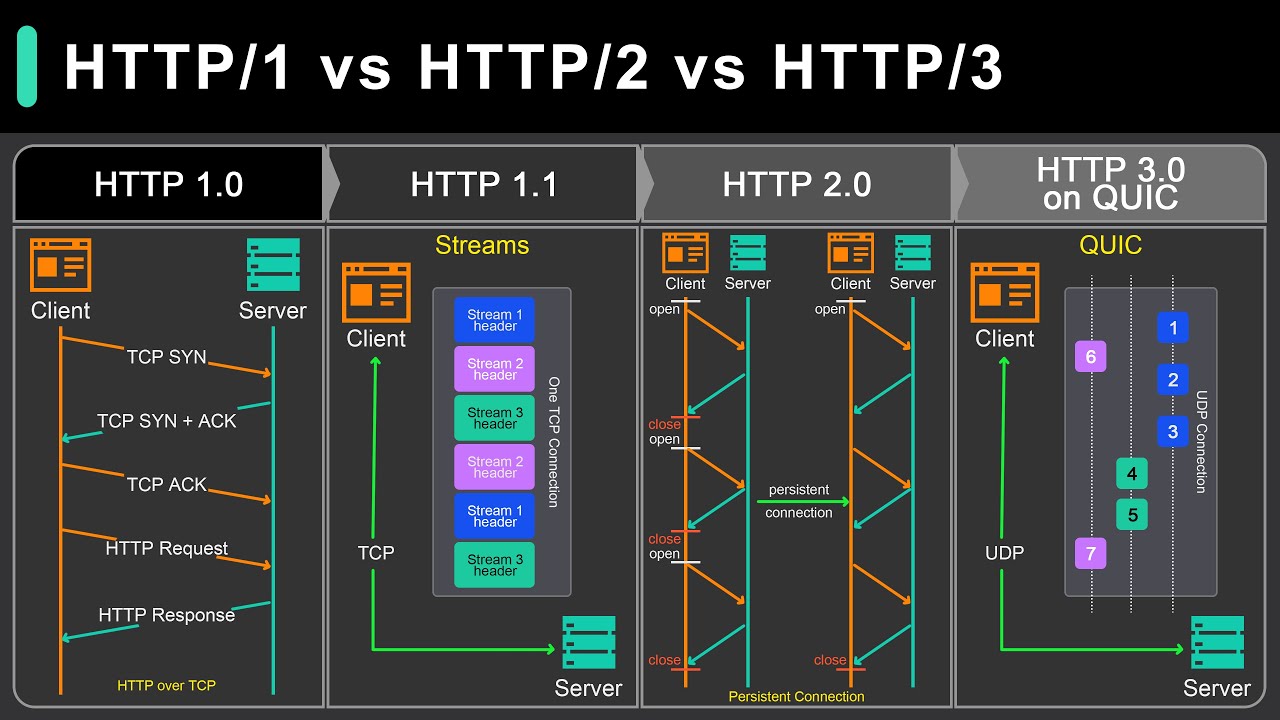
HTTP/1.x,HTTP/2andHTTP/3
HTTP/1#
- Discontinued
- Persistent connection
- Eliminates the need of a new connection in every request
- Pipeline
- Resolves Head-of-Line Blocking
- Allows sending numerous request without waiting for the previous response
HTTP/2#
- Released in 2015
- Format, prioritizes and transport data
- Request priority
- Multiplexing
- Multiple request and responses within the same TCP connection
- Server push
HTTP/3 (QUIC)#
- Started by Google
- New updates to the protocol
- Substitutes TCP for UDP
- Latency, security and efficiency when transfering data
- Reduces latency and handshake
- Improves multiplexing
- Streaming
Response time#
Big difference between latency and response time.
Latency             Processing time     Response latency
========================================================
###############-------------------------################
========================================================
The sum of latency + processing time is the response time.